Thoughts on Christopher Nolan's Odyssey
Aug 05, 2026
Intro
I loved the rowdy build-up to this film.
First Emily Wilson’s translation controversy awoke the Twitter classicists from their hibernation, then we had snippets of the movie creep out and agitate the conversation even more . . .
. . . and then the movie releases.
The shitshow falls silent for three hours. The flashes of action light up evaluating eyes.
Who was vindicated? Who tweeted a false prophecy? Who changed their mind?
And the arguing continued. And I loved it, because an education is only balanced if you listen to both professional scholars and internet autists, merging their wisdom into one.
-
I confess—even as the main character—I’m a little rusty to the Οδύσσεια.
I prefer Homer’s Iliad, and I have yet to give the Odyssey an equally thorough look. It’s why I welcome the online circus; you learn a lot as an onlooker to the debates.
These are my thoughts.
I’ll bounce between my amateur cinema takes, and the more thematic or philosophical critiques; complaining about armour gets old, so I hope to make this more constructive.
We’ll alternate between the good and the bad, at least until the former runs out.
The Good - Composition
Minus the colour grading, the film was elegant with its composition and lighting; from a production of this scale, I expect nothing less, even as a Nolan-doubter.
The soft backlights gave intimacy to the conversations, the splashes of fleeing soldiers sparkled in the sun, and the wide shots did justice to the epic part of the tale.
It was aesthetically pleasing.
The Bad - Odysseus is not Odysseus
There is no “man of twists and turns” here.
Nolan’s Odysseus is flattened into a mopey, gloomy, guilty “hero”, lacking any real depth or exploration of his vices and virtues. He is not wily. He is not cunning. He is not self-serving. He is not virile. He is not proud.
Everything interesting and discussion-worthy of Homer’s character is gutted away here.
He is a boring old Hollywood good guy™, with his singular “flaw” defining his entire character arc.
This flaw is his guilt.
Remember this. Odysseus is a warrior of the bronze age; their concern was of honour and glory through battle—κλέος—and it was the promise of status, loot, and war-brides that kept their spears pointed against Troy’s walls.
While Homer does not shy away from the cruelty of battle, Nolan’s version is more bluntly anti-war; Odysseus’ strategic mastery—the virtue which earns him his great status—becomes the source of a strange new guilt.
He eats himself over “violating Zeus’ law” with the Trojan Horse, and the razing that follows. Matt Damon stumbles through the carnage like a shellshocked stormtrooper, killing Trojans where necessary to save his comrades, until at the end, an innocent woman is beheaded alongside a statue of Athena; this girl turns out to be Odysseus’ mental personification of Athena, and her murder is a symbolic murder of divine law itself, and Odysseus is forced to confront the rotten fruit of his sin.
This trick—the violation of xenia (ξενία)—functions as a betrayal of civilization itself, a herald to the apocalyptic decline, triggering the rise of the terroristic “sea peoples,” who we later discover to include Greeks, just like Odysseus and his comrades.
Homer’s Odysseus would have no such internal struggle.
How could he?
His strategy ended a decade-long stalemate in the most glorious fashion; Troy is breached from the inside and soldiers pour in charged with years of vengeance for their fallen brothers, years of appetite for their treasures, and years of boredom from sitting, camping, waiting.
The Greeks found glory that night, and Odysseus was the epicentre—the “great man” of the day, bound to appear in palace stories for many years thereon.
He won.
The real sacrilege in Homer’s version comes when Ajax the Lesser kidnaps and rapes Cassandra as she sought protection under a statue of Athena, defiled both her temple and an innocent women under her protection.
Nolan assigns this sacrilege to the deception of the Trojan Horse, and perhaps the wider brutality that followed, even though Athena—as well as many other gods—were pro-Greek and happy to see Troy fall.
Mind you, Athena helped build the horse.
To add yet more discord, Nolan contradicts this morality later when Odysseus kills all the suitors; so the Trojan Horse violated xenia against the Trojans who violated it first by kidnapping Helen, but killing the xenia-violating suitors is suddenly ok? What?
I hear it described as an inversion of Bronze Age morality which feels oddly modern and Christian, and I tend to agree. We’ll see more of this confusion later.
The Good - Flow
When the grumble is over and you accept Nolan’s universe for what it is, the story moves along nicely.
Unlike Oppenheimer—my first impression with his films—the Odyssey engaged me all the way, and at no point did we have to drag through dull, twisting dialogue scattered over terrible sound mixing. Terrible doesn’t mean good here.
This movie flowed from start to finish and it was a fun watch, regardless of what you think about the plot.
The Bad - Polyphemus & The Missed Opportunity
Nolan’s changes to the cyclops arc disappointed me.
Polyphemus goes from an intelligent human-like giant to a dumb evil monster: Nolan scraps the dialogue with him, plus the “nobody blinded me!” trick that Odysseus uses to escape, perhaps his second-most famous example of cunning.
It’s a shame because this moment has great thematic depth, but in line with a wider trend, Nolan never lets them bloom beyond ‘this happened, moving on’.
Most will bring up hubris: Odysseus boasts his real name as he flees, which lets Polyphemus bring accurate charges to his father Poseidon, who then tortures the crew with sea and storm.
If only he wasn’t so prideful, right?
Maybe, but there is something deeper to this.
“Polyphemus” is derived from πολύ-, meaning “many”, and φήμη, meaning “speech,” "voice," or “fame/reputation”.
Πολύφημος therefore translates to something like “many-storied” or “much-spoken-of” or “rich in fame”.
Odysseus—a man tied between his war exploits and a journey home, between his identity as a warrior and as King of Ithaca—must walk this line.
To escape Polyphemus, the “many-stories” of the war, and fulfil his homecoming, he must become Οὖτις—nobody—and briefly surrender this new identity.
But equally, he must not forget who he is and what he did; when Odysseus reveals his name, is it hubris, or an affirmation of the self? A grasp on the glory he rightfully earned? Is it a flaw, or a type of reflexive honour?
‘Cyclops, if any mortal human being
asks about the injury that blinded you,
say your eye was burned out by Odysseus,
sacker of cities, son of Laertes,
a man from Ithaca.’
Remember too, that Odysseus’ story of the cyclops is a recollection; we do not see it unfold in real time, so it may either be a fantastical lie to impress his listeners, or maybe an allegory, something closer to a psychological adventure over a real, physical story.
The same is true for many of the other mythological obstacles—are the real? Or are they emotional struggles made flesh?
I wish Nolan could capture anything like this, but he didn’t even bother working with the more straightforward theme of hubris that people are most familiar with.
Odysseus fired off a second arrow at Polyphemus just because he felt angry for his dead comrades. It’s shallow.
The Good - Score
The music was good.
I like when Travis Scott’s FEIN slowly gets louder as Odysseus turns to the camera and says “I am Odysseus, and is my Bronze Age Odyssey” just before the beat drops. Very cool.
But seriously, it was well done. Ludwig Göransson used the instruments of Bronze Age Greece, like the aulos (αὐλός), a double-reeded flute, and the lyre (λύρα), a type of lute you typically see the gods holding.
The Bad? - Menelaus and Feminist Retelling
Nolan’s Menelaus is a wife-beater?
When Telemachus visits him for counsel, Menelaus turns Helen’s face to reveal scars: “Face that sent a thousand ships—maybe only 500 now”, he adds. There’s an icy tension between the couple, and Menelaus is framed as an abusive tyrant over his innocent, kidnapped wife, angry that she would dare defect. Or maybe he ruins her perfect beauty so that it never happens again.
Homer never makes it clear whether Helen left on her own accord or not, but it’s irrelevant—if Paris wanted her, he would have her. If she wilfully left, it would still be Paris who kept her from the invading Greeks, thus keeping the war alive.
She has free will, but no force to back it up.
In the Odyssey, Menelaus and Helen are shown to have reconciled; they peacefully rule over Sparta as if nothing happened. Some adaptations have Menelaus execute her, attempt to execute her until he is overcome by her beauty, or realise she never left in the first place—the divine ‘phantom’ explanation.
You could overlook Nolan’s choice here, since it is plausible in the wider Homeric tradition, but in context, I can’t help but see it as a classic “men bad” trope. This is part of a pattern: Nolan omits the execution of the traitorous servant-women for the sake of avoiding misogyny, and also opts for Madeleine Miller’s victim interpretation of Circe, who turns the men into pigs in fear that they would rape her, as a past sailor did.
Homer never explains her true motive in the original, but she certainly isn’t an innocent victim acting in self-defence.
Nolan also removed the romance between Odysseus and Circe, probably to not disrupt this feminist framing—more on that later.
Interestingly, some reviews accuse Nolan of misogyny (which isn’t exactly a high bar to reach, in their eyes) for minimising the role of Athena and failing to develop characters like Calypso or Penelope. I agree, but I think it comes down to generally mishandled characters rather than simple misogyny.
The Bad - Zeus’ Law
Zeus’ Law refers to Xenia (ξενία)—’guest-friendship’—where host and guest have a moral obligation of hospitality and respect toward one another.
Ancient Greeks were expected to provide food, shelter, and aid to travellers, irrespective of who they were or where they were going.
On the other side of the contract, guests have a duty of respect, courtesy, and modesty, never to become a burden to the host. It’s a two-way relationship aimed at the bettering of relations between families or states.
The famous story of ξενία comes from Zeus, who disguised himself as a beggar and tested a village in Phrygia for their hospitality. Richer houses refused him until one couple, Philemon and Baucis, gave him shelter and provision. Zeus saved this couple from a flood that wiped everybody else away.
Greeks observed ξενία because anybody—even a ragged tramp—may be a god in disguise, and to reject them came at great personal risk.
Nolan clumsily merges ξενία with an extra (Golden) rule: “treat others as you would want to be treated,” something my primary school teachers would stick up on their classroom corkboards, and something I’m sure an Achaean warrior would scoff at, especially during a war.
This has nothing to do with morality of the Bronze Age and is grossly misapplied to the Trojan Horse deception.
It was necessary for Nolan because Odysseus’ ‘defilement’ of ξενία at Troy was a symbolic trigger of the wider corruption of the Bronze Age; rules-based diplomacy crumbles, more and more abandon the law, mistreat their neighbors, and set the scene for the “Sea People’s” coastal terror and the ensuing fall of civilization. Plus more guilt for Odysseus.
Nolan’s universe relies on a lie.
The Neutral - The Gods
In both epics, Homer acts as an omniscient but impartial narrator.
He simply reports.
He does not comment or evaluate or make us feel a certain way, which leaves the morals and values up to us to decipher. It’s what makes these conversations all the more animated.
I’m not disappointed that the personified gods don’t appear in the movie; a human view of the epic, blind to the round table of Olympus, is equally valid and interesting since we interpret the story through a mortal lens, just like Odysseus would.
Athena appears—not as goddess of war and ally of Odysseus—but as his guilty conscience projected into the world, guiding him to redemption and resolution.
It somewhat fits the idea of divinity in the Bronze Age, that gods are both projections of mankind and therefore very much like humans: they squabble, they have sex, they hold feasts, they pick favourites, and they make themselves patrons of worldly things.
Athena, here, is maybe not the Greek Athena, but Odysseus’ individual projection of what Athena would say or do.
Or maybe I am totally wrong—I think out loud here.
The Bad - Colour Grading
The film is attractive, but why are we on an overcast beach in Cornwall?
Are we ever actually in the Mediterranean?
I’m no cinephile, but I hear it’s common for Hollywood to approach history with an over-serious palette, as if to suggest the past was a dreary, dirty slog until we finally figured it out a hundred years ago . . . or maybe when we invented the EU and solved war forever, unlike those barbarous history people :)
It reminds me of how kids imagine history to exist in black-and-white because that’s what it looks like on TV (I am kids).
It’s not the end of the world, and I understand a modern audience wants to see pristine white statues, gothic-looking armour, and Babylon-looking cities, but it would be nice to have a little more vibrancy.
The Bad? - Armour
Let’s just get it out the way. The armour was either goofy, boring, or plain ugly.
Shocker! It wasn’t historically authentic.
Hollywood does as Hollywood does, and it knows it must appeal to modern laypeople over Reddit historians and military nerds . . . but that excuse fails here, because when directors compromise in authenticity, you expect them to win back in style; I could forgive inaccuracy for aesthetics’ sake, but Nolan sacrifices both, and his alternatives are tired and clunky.
Telemachus’ Kevlar vest.
The Trojan’s stone armour, with added crust to make it look more ancient.
Batman Agamemnon (even though the gate scene was a huge aura farm).
There are times it looks stupid enough to shatter immersion, and even when it’s just mediocre—as with the Greek armour—it makes you wonder why they didn’t lean into the flashy side of what truly is authentic.
Realistic Achaean armour was cool as hell:
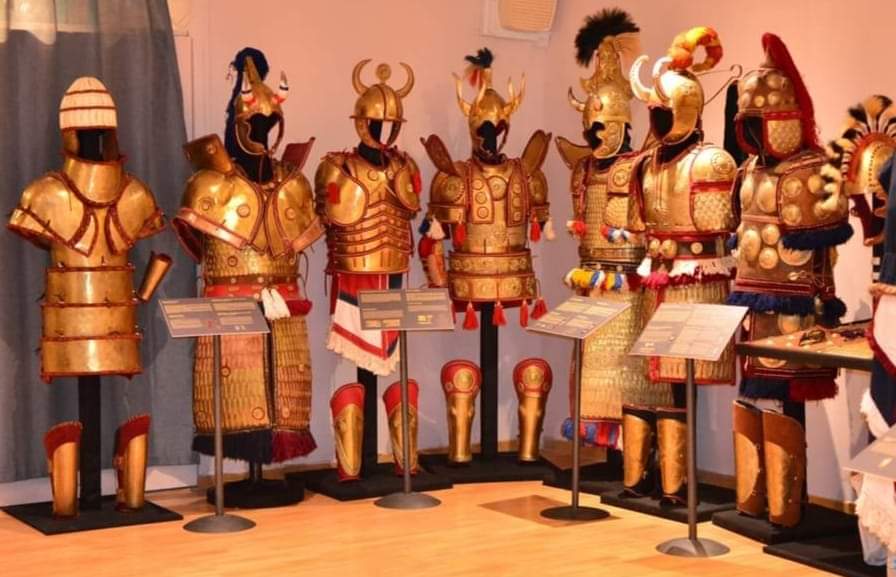
Take creative liberties, fine, but why not make them glimmer in the sun? Why not give them texture and colour? Why not have their bronze truly be bronze? If history gives you something that would look fantastic on the screen, use it!
Instead we got drab brown over grey over beige. Colours to put you to sleep.
The Laestrygonian armour was also ridiculous, but I can at least appreciate how menacing it made them look.
It’s harder to forgive when you consider the sheer scale and research put into the film, and also Nolan’s fidelity to the past where it suits him, like in the music: “It's not like the orchestra existed back then.…” he says, as if realism suddenly matters.
The Bad - Dialogue
For much of the film, the dialogue is bony and blunt, almost like Nolan tried to make it rich and dramatic but it ended up as too literal, like reading from a Wikipedia page.
I don’t watch Netflix so this is a guess, but I sensed what people call “Netflix dialogue,” where ideas and plot devices are parroted over and over throughout the film to keep viewers in the loop as they scroll on their phone, paying half-attention to the series.
I felt like Nolan treated the viewer like a fool by over-explaining things.
It wasn’t terrible, but I remember twisting my nose in cringe a few times. Antinous, notably, came off like a “bwahahah I’m evil” Disney-villain; he pushed me out the scene with every word.
I felt zero emotional connection to the characters, perhaps except the struggling Eumaeus, and I didn’t care too much of their fate. Was it the dialogue? Was it the acting? The philosophical shallowness? Something was missing.
Not even the dying Argos made me feel anything; it was far more touching in the book.
Plus, in Nolan tradition, the sound mixing was pretty bad; dialogue was tricky to make out at times, and I imagine it would have been far worse if the cinema I went to did not lower the volume themselves. They made the right call.
At least it wasn’t Oppenheimer, I guess.
The Bad? - Strange Lack of Sex
Sex and ‘romance’—if you can call it that—is a big part of the Odyssey.
Odysseus is broad and handsome, desired by every woman he encounters (can confirm); he threatens and then sleeps with Circe to essentially “soften” her into freeing his men, he is kept as a sex-captive by Calypso for many long years, and though it strays from the original, the sirens are often depicted as obstacles of physical desire—maybe even lust.
Finally, Homer’s Odysseus celebrates his return by sleeping with Penelope in the same bed he used to prove his identity.
Nolan’s approach is almost asexual.
Circe is reduced to a feminist revenge fantasy.
Calpyso is reduced to a therapist.
Odysseus has no rizz.
He omits these sexual encounters in the film, a strange decision given the thematic potential that viewers would love to chew on, especially with Circe. It’s also not accurate.
In his defence, the siren scene was adapted thoughtfully; it became about his self-consciousness and regret surrounding both the Great Sin at Troy, and the home he left behind, this nostalgia, this longing for something he could never have again. In the Nolan-verse, it made sense and finally provokes introspection.
To be clear, I don’t propose full-on softcore porn sex scenes or the gooner-bait you see on Netflix. Just a tasteful and constructive inclusion of what was. Maybe we just didn’t have time, and I get that.
The Bad - No Real Depth
The Odyssey is a book that matures with you.
The more analysis I read—and the more I hear from those same internet classicists—the more self-conscious I get; I don’t really know anything.
For example, I reread the Iliad this month with the confidence that I’d finally get it.
Two conclusions were born:
First, how did I miss all that before? Am I a moron?
Second, I will never get it. Just a little more each time.
The Odyssey is the same.
It is a masterpiece of western civilization—and arguably its beginning—because of its thematic depth and how much it tells us about ourselves: of heroism, of home, of identity, of memory . . .
. . . but what does Nolan do with any of it?
Very little.
Despite the ample room, the movie bottlenecks the emotional and psychological conversations we could have had, and replaces it with something monolithic, inaccurate, and less thoughtful.
I like films that leave you with something to chew on, but this wasn’t so for the Odyssey.
Even Emily Wilson, whose translation inspired Nolan, had the same charge against him.
Also, is it just me or is Matt Damon a very passive take on Odysseus? At times, I felt he was more a spectator to the story rather than the man these themes unfold around.
The Bad - Casting Choices
In an ideal world, and in the name of fidelity and immersion to the Homeric universe, I would like to see Greek actors, or at least actors who look Greek.
Lupita Nyong’o isn’t Helen of Troy.
Elliot Page’s fake deep voice and toddler run was laughable.
Why is Travis Scott there?
It gets tiring to see “Zendaya as Zendaya” for the millionth time, the American accents, the mandatory Diversity™ that only seems to work in one direction, explained away with historical copes by redditors who are afraid to offend their golden bull of ‘historical accuracy’ once it inevitably clashes with their progressive worldview.
But again, it’s Hollywood.
This is what they do, and the culture war outrage slop is naïve at this point; you cannot get angry at a dog for barking.
The Bad - Combat
Let’s look at three combat scenes from The Iliad:
Then Meges killed Pedaeus, an illegitimate son of Antenor's whom bright Theano, Antenor's wife, had conscientiously brought up like a child of her own to please her husband. The great spearman Meges caught this man up and hit him with his sharp spear on the nape of the head. The point came through between his teeth and cut out the root of his tongue. He collapsed in the dust and bit the cold bronze with his teeth.
- -
Then he [Diomedes] went after Xanthus and Thoön, sons of Phaenops, both late-born. Phaenops was old now and ailing and had no other son to whom he could leave his wealth. Diomedes killed them both, depriving them of their precious lives and leaving their father only tears and a broken heart. He never welcomed them home alive from the war. Relatives divided up the estate.
- -
So he [Acamas] spoke, and his boasting stung the Greeks. It went straight to the heart of Peneleos in particular. He made for Acamas, but Acamas did not stand up to his attack and it was Ilioneus who fell to lord Peneleos. He was son of the sheep-owner Phorbas, a favourite in Troy of the god Hermes who had made him a rich man. But Ilioneus' mother had given Phorbas no other child, and now Peneleos struck him under the eyebrow in the socket of the eye. The spear dislodged his eyeball, pierced the eye-socket and came out at the back of his head. He sank back, stretching out both his hands. But Peneleos, drawing his sharp sword, hit him full on the neck and brought head and helmet tumbling down to the ground. The heavy spear was still stuck in the eye as Peneleos raised it aloft, like a poppy-head, for the Trojans to see, and spoke in triumph:
'Trojans, do me a favour and instruct Ilioneus' father and mother to start lamenting him at home. After all, the wife of Promachus, son of Alegenor, will never have the happiness of seeing her husband return when we Greeks sail from Troy.'
So he spoke, and the knees of all the Trojans trembled, and each man peered around to find some escape from sudden death.
Warfare according to Homer was gory, personal, and tragic. He gives us individual snapshots of the soldier’s life at home to remind us of their humanity, only to then narrate their brutal death and shatter any hopes of nostos. Though war is the arena where glory is earned, Homer equally never shies away from its terror—that is an anti-war theme Nolan could have added, and a more powerful one at that.
Nolan instead anonymises the war. Greeks never interact with the Trojans they fight; there are no insults, no challenges, no boasts, no displays of mutual honour.
The Trojans are never named. Their faces are never shown. They are a mass of NPC grunts for the Greeks to mow down. Sure, I wouldn’t expect the same depth as the passages above, but this was a golden opportunity for some introspection into war, glory, and tragedy, which Nolan seems to want anyway.
Again, the book is doing the heavy lifting for you—why not just use it as it is?
The fight scenes themselves are mid. They’re too stiff and scripted. I’d like them to be more organic and especially more brutal: let us feel the violence of the bronze age and see the horrific maiming of the melee. I want spears through necks, swords hacked through temples, blood painting bronze, not for edginess’ sake, but to let the war speak for itself and for Nolan’s guilt theme to hit harder.
The Iliad’s combat gave me nervous goosebumps. If a book can do it, a film ought to do it better.
The fight with the suitors was exciting, but also had it’s flaws; we’ll discuss that when it comes.
The (mostly) Bad - The Ending
Overall, I enjoyed the suspense of Odysseus’ return and the cautious reconnaissance of the situation. The looming vengeance is exciting, the bow challenge is done justice, and—having accepted Nolan’s diversion from the original—the dialogue with Penelope is touching, with a nice twist to explain who Athena really is.
Praise out of the way, I have three main criticisms.
First, the fight scene could have been much better if Nolan was faithful to the original.
Homer has Odysseus backed up by Telemachus, Eumaeus (who is neither blind nor lame), and Philoetius (who I believe does not appear in the film). To even the odds, Odysseus shoots the 108 unarmed suitors from a choke point while the others guard the doors and prevent escape. Odysseus arms himself properly, and Athena sends the suitors into an aimless panic, tipping the combat decidedly in our hero’s favour.
In addition to the bloated drunkenness of the suitors, all of these advantages add up to make the fight plausible. Nolan scraps most of them and it ends up feeling . . . awkward.
Odysseus is now a one-man-army who quickscopes his enemies while the others bumble around in the background, waiting for their turn to die. There isn’t much tactical quick-thinking going on, and it’s very much a ‘movie-fight’ with no effort to make it plausible.
Telemachus does manage to stop Melanthius (or his substitute) from dropping weapons down to the suitors, but it’s not enough.
Second, Odysseus and Telemachus never kill the twelve maidservants who Eurycleia—the trusted nurse—pointed out as being disloyal by sleeping with the suitors.
In the book, Telemachus forces them to clean the bloody hall before they are executed by sword, as per Odysseus’ suggestion. However, Telemachus has another idea—a ‘clean death’ is too good for these women, these traitors, who brought shame upon his house, and so he brutally hangs them instead. I’m not sure if ‘clean’ here means ‘less painful’ or ‘honourable’, which might change Telemachus’ reasoning, but that’s not the point.
Nolan removes this scene because it was “misogynistic,” and instead has Penelope indirectly kill off Melantho, the only overtly disloyal maidservant (although I don’t remember seeing her actually die; she is just pushed into the hall during the combat).
Even if Nolan is correct here—that it was indeed a show of chauvinistic male brutality—it was still a mistake to remove it.
Some argue that killing the maidservants was wrong because they were slaves, therefore lacking any real agency; even if they did sleep with the suitors, what power do they have to refuse their advances? Either through direct threat or underlying coercion? That is certainly a fair defence.
Others would argue how their laughter and amusement as they slip out of Odysseus’ house marks them as not only complicit, but eager in their disloyalty, and that while their side of the story is never elaborated, we can see the obviously-guilty Melantho as representative of all of the chosen maidservants, as a kind of narrative device for brevity’s sake.
I wasn’t there. I don’t know what was right. There are certainly valid arguments to justify both arguments, plus a hundred more moderate positions in between.
It’s a shame Nolan didn’t include this not because I wanted to see the maidservants dead, but because—again—it makes Odysseus and Telemachus more dimensional.
Was this justified?
How could they do such a thing?
Is Odysseus really even a Hero? What did the Greeks think of this?
I believe Homer wanted to provoke these thoughts in his audience.
Telemachus also kills Amphinomus, a well-behaved suitor who previously backs up beggar Odysseus and even defends Telemachus from death, twice. Odysseus warns him to flee, but Athena keeps him in the room for Telemachus to kill. It is a cruel and unjust fate.
How many other well-behaved suitors died purely by circumstance? That they were in the wrong room with the wrong people at the wrong time, simply wishing to marry Penelope after 20 years of a kingless Ithaca? All of these questions grey the situation.
It is yet another opportunity to unflatten Odysseus (with his son) and weigh up his virtues and vices, his moral character which we must reconcile with thousands of years later. Nolan scraps it for shallow misogyny. It’s boring, cowardly, and sterilised.
Third—and I’ll be quick—the ultimate ending is weak. In Nolan’s story, it’s unusual but plausible: guilt-ridden Odysseus sails away with his wife to visit Hades and ‘honour his fallen comrades’ whom he sees as having failed. This trip is one of exile and penance, though Homer’s Odysseus would have never had the moral push for either.
One article suggested how the sailing into the sunset was symbolic of them ‘chasing the fading light of civilization’ injured by war and the decay of the social fabric we saw earlier. Odysseus was one man to break the world, yet another man in the cycle of light and darkness, of sunrise and sunset, of death and rebirth.
It was also strategically sound. Odysseus expected the suitors’ families to retaliate just like they did in the book, at least until Athena ended the conflict.
Conclusion
It wasn’t the Odyssey, but I liked it.
Nolan lies about who Odysseus is and what he did; we are not offered transparency into the Bronze Age psyche, as Homer provides, but a modernised Odyssey-shaped phantom held to contemporary standards.
It’s like Nolan wrote his own story and used Odysseus as the vessel because it was close enough.
So if you book a ticket expecting a faithful, thoughtful adaptation of the Odyssey, you won’t like the film.
If you accept—like I did—that Nolan was going his own way and doing something different, the film becomes far more watchable. It is a unique story wearing a mask from the past. Not great, barely even good, just decent.
I hope it inspires people to pick up a copy for themselves and make sense of Homer directly. Even writing this review, I learned a lot about the Odyssey—that is the best thing Nolan did for me.
I give it a 5.5.
Other interesting reviews/pieces:
https://www.lrb.co.uk/the-paper/v48/n14/emily-wilson/an-uncomplicated-man
https://cbrobertson.substack.com/p/a-final-review-of-nolans-odyssey
Never miss a new issue
Sign up for letters on learning, lifestyle, and creativity.